
Bluetooth Software 1.5 for Mac OS X: Information and Download This document contains the Bluetooth Updater 1.5 information and a link to the Bluetooth Updater 1.5 software. When you have a Bluetooth enabled Macintosh you can use Bluetooth technology to communicate wirelessly with devices such as mobile phones, printers, keyboards, PDAs and more. Broadcom WiFi/Bluetooth Guide WiFi and Bluetooth working out of box on macOS with Apple branded Broadcom BCM94360. Enables specific half mini and M.2 BCM94352 on macOS with methods described below. Credit: RehabMan This thread does not support: macOS/Continuity Atheros/Qualcomm. The Apple Support Downloads page is most useful for finding software for more recent older Macs, particularly anything that is running a version of Mac OS X, even if it’s no longer a supported or updated system software release, like for Macs running Mac OS X Tiger 10.4 or Mac OS X Snow Leopard 10.6.5.
What's Bluetooth?
Bluetooth is a wireless technology that makes short-range connections between devices (like your Mac, and a mouse or keyboard) at distances up to 10 meters (approximately 30 feet).
And with Bluetooth, your iPhone or iPad can create a 'Personal Hotspot' to provide Internet access for your Mac through your wireless service provider. Learn more about creating a Personal Hotspot with your iOS device.
Find out if your Mac has Bluetooth
Most Mac computers come with Bluetooth technology built-in. You can check to see if your computer supports Bluetooth:
- Look for the Bluetooth icon in the menu bar. If the Bluetooth icon is present, your computer has Bluetooth.
- Choose System Preferences from the Apple menu, then click Bluetooth. If the Bluetooth preferences lists options for enabling Bluetooth and making your device discoverable, Bluetooth is installed.
- From theApplemenu, choose About this Mac, then click More Info. Select Bluetooth from the Hardware section. If the Hardware Setting section shows information, your system has Bluetooth installed.
About Bluetooth menu bar icons
The Bluetooth menu bar icon in the upper-right of your display gives you information about the status of Bluetooth and connected devices:
Bluetooth is on, but there are no devices connected to your Mac. If you expect a wireless device to be connected, make sure it's turned on.
Bluetooth is on and at least one wireless device is connected.
At least one wireless device has a low battery. Click the Bluetooth icon to identify the affected device, then replace its batteries.
Bluetooth is off. Click the Bluetooth icon using a wired mouse or trackpad or the built-in trackpad on your Mac notebook and select Turn Bluetooth On.
Mac computers without built-in trackpads won’t allow Bluetooth to be turned off unless a USB mouse is connected.
Bluetooth is offline and unavailable. Restart your Mac. If the Bluetooth status doesn’t change, disconnect all USB devices and restart your Mac again. If Bluetooth continues to show as unavailable, you might need to get your Mac serviced.
Pair your Mac with a Bluetooth device
Bluetooth wireless devices are associated with your computer through a process called pairing. After you pair a device, your Mac automatically connects to it anytime it's in range.
If your Mac came with a wireless keyboard, mouse, or trackpad, they were pre-paired at the factory. Turn on the devices and your Mac should automatically connect to them when your computer starts up.
If you purchased your Apple wireless devices separately, learn how to pair them with your Mac.
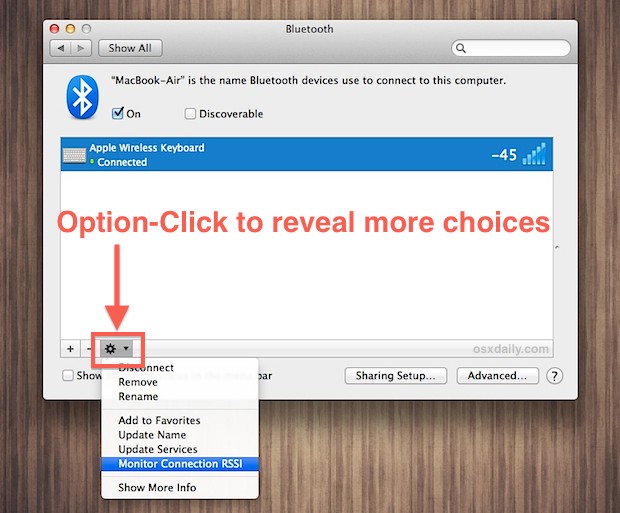
After you pair a Bluetooth device with your Mac, you should see it listed in Bluetooth preferences:
Remove a Bluetooth device from your Mac
If you want to remove (unpair) a Bluetooth device from your Mac's device list, follow these steps:
- Choose Apple menu > System Preferences, then click Bluetooth.
- Hover the pointer over the device you want to remove, then click the button that appears next to the device's name.
After you remove a Bluetooth device, you'll have to repeat the pairing process if you want to use it again.
Connect to Bluetooth devices after wake or startup
Bluetooth devices are usually available a few moments after your Mac completes its startup process. After waking from sleep, your Mac should find Apple wireless devices right away. Other wireless devices can take up to 5 seconds to be recognized. You might need to click a button on your wireless mouse to wake it up.
Some Bluetooth devices, such as audio headsets, might disconnect to conserve the device's battery power after no audio or data is present for a certain amount of time. When this happens, you might need to push a button on the device to make it active again. Check the documentation that came with your device for more information.
Wake your computer with Bluetooth devices
You can click your paired Bluetooth mouse or press a key on your paired Bluetooth keyboard to wake your Mac. You might need to press the space bar on the keyboard.
If clicking the mouse or pressing a key doesn't wake the computer, you might need to allow wireless devices to wake up your computer:
- Choose Apple menu > System Preferences, then click Bluetooth.
- Click Advanced.
- Select the checkbox next to Allow Bluetooth Devices to wake this computer.
Connect multiple Bluetooth devices to one computer
The official Bluetooth specifications say seven is the maximum number of Bluetooth devices that can be connected to your Mac at once.
However, three to four devices is a practical limit, depending on the types of devices used. Some devices require more Bluetooth data, so they're more demanding than other devices.t perform reliably, try turning off devices you aren't using or unpair them from your Mac.
Fix interference from other household devices
Bluetooth shares the 2.4 GHz ISM band with other household devices such as cordless telephones, wireless networks, baby monitors, and microwave ovens. If you see issues with your Bluetooth devices that you suspect might be due to frequency congestion, see AirPort and Bluetooth: Potential sources of wireless interference for further information.
Press startup keys on a Bluetooth keyboard
You can press keys immediately after startup to have your Mac perform functions like selecting a startup disk, using the recovery partition, or resetting NVRAM.
Learn more at Startup key combinations for Mac.
I have quite a number of Bluetooth devices connected to my iMac: Apple's Magic Mouse 2, Magic Keyboard, and the original Magic Trackpad. (Yes, I use both the mouse and the trackpad.) There's also a pair of Sentey Bluetooth Headphones and a Satechi numeric keypad. Up until macOS Sierra, I hadn't had any issues with these devices at all.
Since Sierra, though, my trackpad would occasionally disconnect then reconnect, which was annoying but generally harmless, given its role primarily as a shortcut touchpad. Much worse, though, were the Bluetooth headphones: I would hear horrible stuttering and skipping at random but frequent intervals. The audio dropouts were bad enough to make using the Bluetooth headphones impossible.
What follows isn't really a tip per se, because there's nothing here that shows how I fixed the problem for good. I have, however, found a workaround that restores my audio, which is something, at least. But if you're having Bluetooth-related issues, you may find this writeup useful, as I cover some of the tools I used to try to resolve my Bluetooth issues.
[Note: This article was updated to include information on how to use Apple's free developer accounts to download one of the tools I used—thanks to Torben for pointing this out in the comments; I had no idea there was still a free level of developer account.]
At first, I suspected the headphones as the cause of the problem, as they were quite cheap when I bought them. (I think they've since been discontinued, so they're now a lot pricier.) However, when I used the same headphones with my iOS devices, I'd have no dropouts at all.
If it wasn't the headphones, it had to either be interference from some other device in our home, or something specific to my iMac's setup. Given the headphones worked fine with iOS devices, even when sitting in the same room as the iMac, I figured it had to be an iMac issue.
Investigating the problem
The next time I heard the audio interruptions, I launched Console (in Applications > Utilities) and found hundreds of ton of messages like these:
The messages were logged every 0.02 seconds, and would repeat for hundreds and hundreds of entries. If I toggled Bluetoooth off and then on again (with a USB keyboard/mouse plugged in), things would get better…for a while. Then the audio skipping would start again, along with the flood of console messages. So I dug further.
Getting more control over Bluetooth
As a first step, I enabled Bluetooth logging using this handy tip, which reveals a Debug menu item in the Bluetooth menu bar item. Just hold down Shift and Option when you select the menu, and you'll see the Debug menu:
With logging enabled, I was able to see an additional set of messages that always preceded the audio dropouts:
This seemed to show one of the devices disappearing, and it was followed by more Bluetooth-related error messages.
I thought maybe it was time to try something else from the hidden Debug menu: Reset the Bluetooth Module. When I did this, all my devices vanished for a bit, then came back. Sadly, so too did the audio dropouts. So that wasn't a fix. I also tried 'Factory reset all connected Apple devices.' Same result: no change.
Isolating the problem
At this point, I figured there must be interference from one of my Bluetooth devices, so I started experimenting, turning one off at a time and replacing it with its wired counterpart. This turned out to be the key to finding the cause of the problem: When my Apple Magic Mouse 2 is disconnected, audio playback over Bluetooth is perfect. My trackpad hasn't disconnected, either. But when the mouse is on, sometimes audio playback is perfect, but oftentimes it's unusable.
So that's that—there's some sort of issue with my Apple Magic Mouse 2 that causes audio interference. Not all the time, but a lot of the time. So is my mouse bad? I don't know. I had no issues with these exact peripherals under El Capitan. I might have to purchase a new mouse to see if the problem goes away (we do have another Mac it could be used on, so it wouldn't be a total waste of money.) For now, I've found that if I turn the mouse off for a few minutes then turn it back on, I'll get a good long run of unbroken music playback. (I could just leave it off and use the trackpad, but I like the precision the mouse offers.)
Knowing the source of the problem, and having a workaround of sorts, is probably good enough for me for now. I'm hoping this is some sort of macOS bug that's fixed in a future update. But before I wrap this up, just a little aside on a tool that can really help you see what's going on with your Bluetooth devices…unfortuantely, while the tool itself is free, it requires a $99 per year membership fee, payable to Apple…and you can get it for free!
Diving deep into Bluetooth
Even though I don't write any 'real' code (AppleScripts and shell scripts are about as close as I come), I'm enrolled in Apple's $99/year developer program. True, I have to be for my day job, but even before that, I was a registered developer—primarily to gain access to beta versions of macOS (Mac OS X). But even if you don't pay, you can still download Xcode and other developer tools—including something called the Hardware IOTools for Xcode 7, which includes a nifty little app called Bluetooth Explorer.
Get the Bluetooth Explorer app
Downloads Bluetooth Device For Mac Os X 10.8
To get this app for yourself, start by logging in on the Apple Developer page using your usual Apple ID. You'll have to read and agree to a couple of agreements, but once you do that, you're in as a 'free' developer. (The rest of the links in this section will require you to be logged in.)
You can download Xcode from the Downloads page, but you don't need that huge package. Instead, head over to the More Downloads page, and search for Hardware IO tools:
You want the first one … alternatively, use this link to download them directly: Hardware IO Tools for Xcode 7.3 (12.7MB). After downloading, open the disk image and drag Bluetooth Explorer wherever you'd like to keep it—I have a Dev Utilities folder for such tools.
Use Bluetooth Explorer
Bluetooth Explorer really lets you dig into all the nitty-gritty of Bluetooth. I'm not sure if it will help solve my problem or not (I have it running now, waiting for the problem to recur), but it certainly looks like it could provide more clues, if not an outright answer.
Here's how it looks, set up to view my connected devices, with pretty much every available window shown.
Downloads Bluetooth Device For Mac Os X 10.10
Of particular interest to me are the Event Log (large top center window) and the link characteristics graphs (left side). I'll keep my eye on these graphs the next time the dropout problem recurs. Obviously, you don't need every window open to use the apps—choose which windows to see via the Tools menu, or get access to many of them via the Dashboard window—just press Command-0.
Downloads Bluetooth Device For Mac Os X 10.13
And yes, this tool scores high on the geekery scale. But if you're stuck with a Bluetooth problem, it just might be the geekery you need to solve it.
Downloads Bluetooth Device For Mac Os X 10.7
Related Posts: